



Warehouse automation
17 August 2026
4-way pallet shuttle: what it is and how it works
Discover in detail how the 4-way pallet shuttle works, what its components are, and why it is used in modern automated warehouses with 4-way shuttle systems.
The 4-way pallet shuttle represent one of the most advanced technologies in the field of intralogistics automaton. Thanks to its multidirectional movement capability and intelligent flow management, this system is now at the core of many high-density automated warehouses.
What is a 4-way pallet shuttle
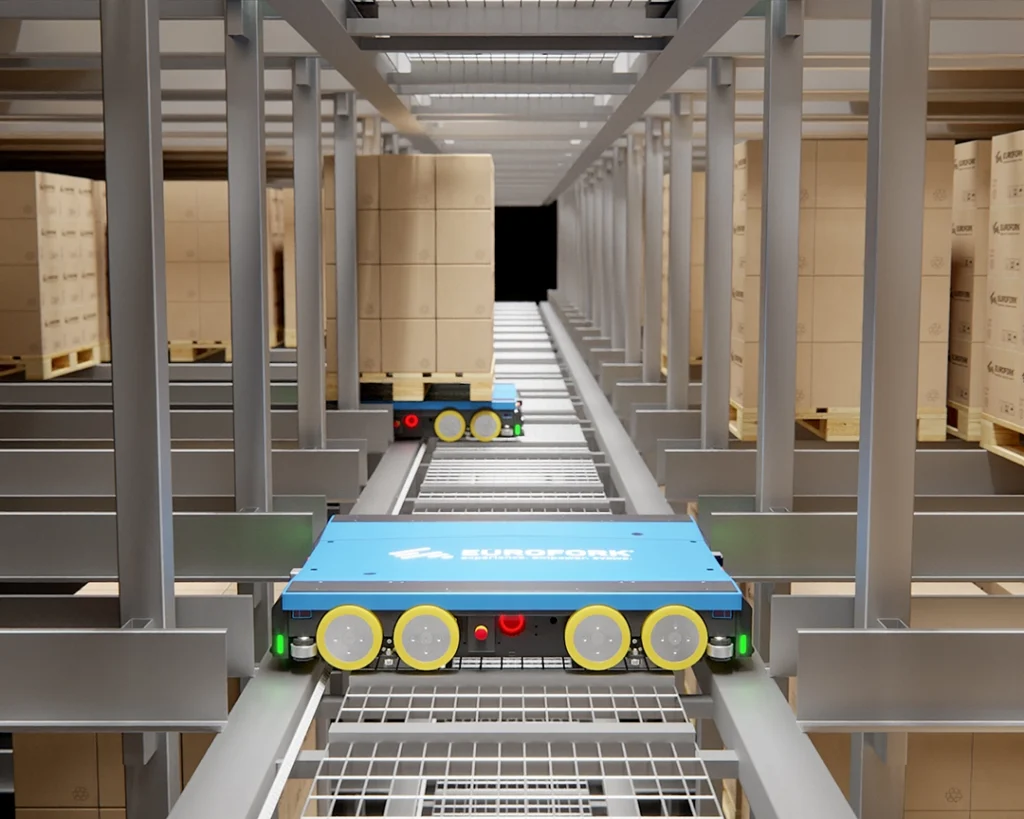
A 4-way pallet shuttle system is an automated solution consisting of robotic shuttles that autonomously handle and transport pallets within high-density racking system.
Unlike traditional systems, these shuttles:
- Move in four directions, both longitudinally and transversely
- Can change levels with lift, which can also be used for roaming shuttles
This technology is part of AS/RS (Automated Storage and Retrieval System) solutions and enables warehouse to be transformed into a dynamic and fully automated environment.
How does a 4-way pallet shuttle work
To truly understand how the 4-way pallet shuttle works, it is useful to examine the system’s main components:
- Battery-powered autonomous shuttles
- Multi-level racking systems
- Lifts or vertical transfer elevators
- Conveyor systems
- Control software (WMS/ WCS)
The operating process follows a precise workflow:
- The pallet is introduced into the system through an inbound station
- Conveyors transport it to the lift
- The lift transfers it to the correct storage level
- The 4-way shuttle takes the pallet and transports it to the assigned storage location
The system operates completely automatically, with software that assigns missions, optimizes travel routes, and coordinates the shuttles movements in real time.
Movement along the X, Y and Z axes
The true distinguishing feature of the four-way pallet shuttle system is its ability to perform three-dimensional movement. Let’s take a closer look at the three axes of movement.
X-axis: longitudinal movement along the aisle
The X-axis refers to movement in depth along the storage lane:
- The shuttle enters the storage channels
- It deposits or retrieves pallets
- It enables multi-deep storage configurations
This movement is essential for achieving high-density storage
Y-axis: transverse movement between aisles
The Y-axis allows the shuttle to:
- change lanes without manual intervention
- move laterally across the racking system
- access multiple storage channels
This capability eliminates the need for forklift handling or dedicated transfer vehicles, making the system significantly more flexible.
Z-axis: vertical movement between the levels
Vertical movement is achieved through elevators:
- they transfer pallets and shuttles between levels
- they enable full utilization of the warehouse height
- they support multi-level storage configurations
Thanks to this axis, the system becomes a truly three-dimensional storage environment, maximizing the available warehouse space.
Advantages of the 4-Way Pallet Shuttle System
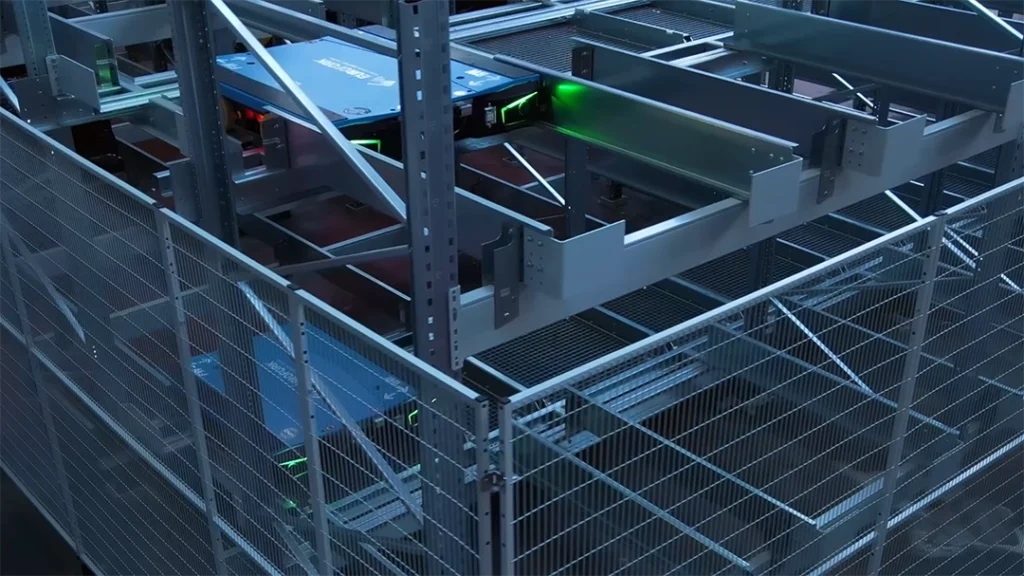
Implementing a 4-way pallet shuttle system in an automated warehouse offers numerous benefits:
- Maximum storage density: By reducing the number of access aisles and making full use of storage depth, the system significantly increases warehouse storage capacity.
- Greater operational efficiency: Multiple shuttles can operate simultaneously, reducing waiting times and increasing overall throughput and productivity.
- Flexibility and adaptability: The system can easily adapt to complex layouts, changing SKU profiles, and fluctuating inventory volumes.
- Reduced labor requirements: automation minimizes human intervention within storage aisles, improving workplace safety and reducing the risk of handling errors.
- Scalability: system performance can be increased by adding more shuttles or storage levels without requiring significant structural modifications.
- Cost optimization: better space utilization, fewer errors, and increased operational efficiency contribute to lower overall operating costs.
Applications of the 4-way pallet shuttle
The 4-way pallet shuttle system is ideal for:
- High density warehouse
- Distribution centers
- Food industry facilities and cold storage warehouses
- Manufacturing and industrial production environnement
- Logistics and retail
These solutions are particularly effective in applications where it is necessary to combine high storage capacity with fast material handling and throughput rates.
Difference Between a Traditional Pallet Shuttle and a 4-Way Shuttle
Compared to other pallet shuttle systems:
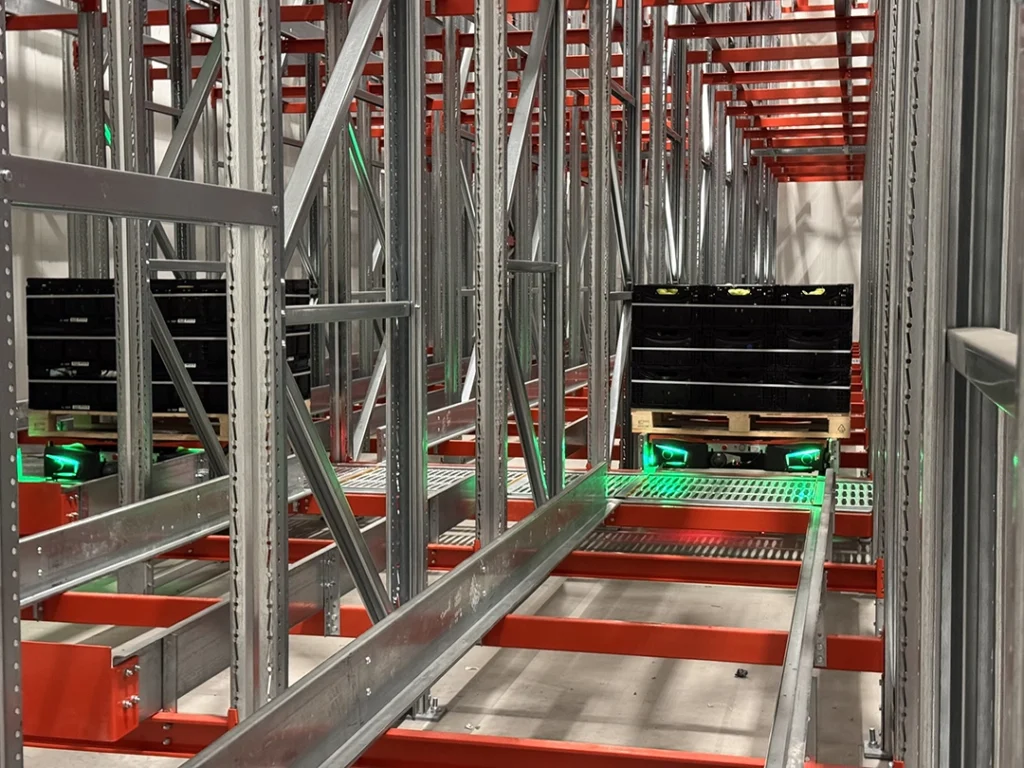
- Traditional pallet shuttles generally move along the storage lane (X-axis) and require handling equipment or operator intervention to be transferred between lanes or levels.
- The 4-way pallet shuttle can move autonomously along the X and Y axes and, through integration with elevators, operate across multiple levels (Z-axis) without the need for manual transfer operations.
- Unlike semi-automated pallet shuttle systems, such as radio shuttles, the 4-way system eliminates the need for manual movements between storage channels, resulting in a higher level of automation and operational flexibility.
The result is a warehouse that is more flexible, dynamic, and fully automated.
CONCLUSION
The 4-way pallet shuttle is a key technology for next-generation automated warehouses. Thanks to its ability to move along the X, Y, and Z axes, it enables intelligent pallet handling while maximizing the use of space, time, and resources.
Understanding in detail how the 4-way pallet shuttle works makes it easier to select efficient and scalable storage solutions, which are essential for addressing modern logistics challenges and building a high-performance automated warehouse.

Contact Us
To request further information, fill out the form. Our sales department is available to help you with your next intralogistics automation project.