



Warehouse automation
8 October 2026
What Is an AS/RS: Automated Storage and Retrieval Systems
AS/RS: definition, features, and role in warehouse automation
In the field of intralogistics and warehouse automation, the acronym AS/RS (Automated Storage and Retrieval System) refers to a category of systems designed to automatically perform the storage and retrieval of load units within a warehouse structure.
From a technical perspective, an AS/RS is not a single technology or a specific machine, but rather a coordinated set of hardware and software components that enable the movement, storage, location tracking, and retrieval of materials with minimal or no human intervention.
For this reason, the term is used as an industry definition to describe the entire family of automated systems dedicated to inventory management, regardless of the technology employed for load handling.
The growing adoption of AS/RS solutions reflects a broader transformation of the supply chain. According to the 2025 MHI Annual Industry Report – The Digital Supply Chain Ecosystem, 55% of supply chain decision-makers are increasing investments in technological innovation, and 60% of companies expect to invest more than one million dollars, confirming the increasingly central role of automation and digitalization in logistics processes.
What Does AS/RS Mean?
The acronym AS/RS stands for Automated Storage and Retrieval System, which can be translated as an automated storage and retrieval system.
These systems were developed to automate two fundamental warehouse logistics functions:
Storage of goods in available locations
Retrieval of materials when required for production, order fulfillment, or shipping
The objective is to ensure that each load unit is moved to the correct storage location and subsequently retrieved in the shortest possible time while maintaining high levels of accuracy and traceability.
How Does an AS/RS Work?
The operation of an AS/RS is based on the integration of:
- Storage structures
- Automated handling devices
- Internal transport systems
- Warehouse control and management software
When an item enters the system, it is identified and assigned to a specific storage location. An automated machine then transfers the load to the designated position. When the material is required, the software sends a command to the system, which retrieves the load unit and transfers it to the designated output point.
The entire process is managed through digital mission control, enabling real-time monitoring of movements and inventory.
This approach aligns with the evolution of data-driven supply chains. The 2025 MHI Annual Industry Report highlights how companies are increasingly investing in logistics ecosystems capable of integrating automation, data visibility, and real-time operational control.
What Components Make Up an AS/RS?
Although configurations may vary, an AS/RS generally includes several fundamental elements.
– Storage Structures
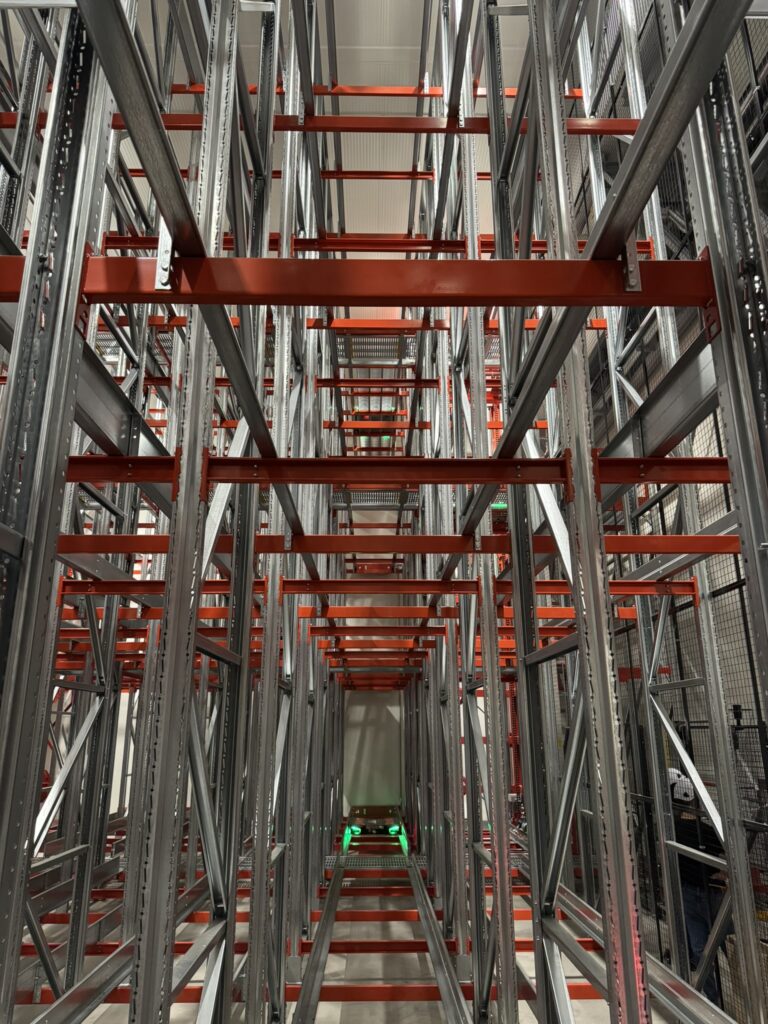
Racking systems represent the physical infrastructure used to house load units. They can be developed vertically or in depth, depending on warehouse density and capacity requirements.
– Storage and Retrieval Machines
These are the devices that physically move goods within warehouse aisles. The most common technologies include stacker cranes, automated shuttles, and other robotic systems.
– Transport Systems
Roller conveyors, conveyors, elevators, and automated vehicles provide the connection between the AS/RS and other operational areas of the facility, such as receiving, production, and shipping.
– Management Software
WMS (Warehouse Management System) software and control systems coordinate all operations, assigning storage locations, monitoring inventory, and managing material flows.
The importance of software in automated warehouses is expected to continue growing. Companies are increasingly directing investments toward digital ecosystems that integrate automation, data, and real-time decision-making processes, making software an essential component of any modern AS/RS.
What Load Units Can an AS/RS Handle?
One of the most important aspects of understanding the AS/RS concept is that these systems can be designed to handle different types of load units.
– Pallet AS/RS
These systems are used for heavy loads and large load units. They typically operate in high-density warehouses with significant vertical development.
– Bin and Tote AS/RS
These systems handle cartons, bins, trays, and containers used in picking and distribution operations.
– Small Parts AS/RS
They are employed in applications that require high precision and frequent retrieval operations for lightweight items.articoli leggeri.
The Main Types of AS/RS Systems
From a technical classification perspective, the term AS/RS encompasses different automation architectures.
– Stacker Crane Systems
These systems use telescopic forks or shuttles moving along warehouse aisles between racking rows to store or retrieve load units. They are among the most widely adopted configurations in the automated warehouse sector.
– Shuttle Systems
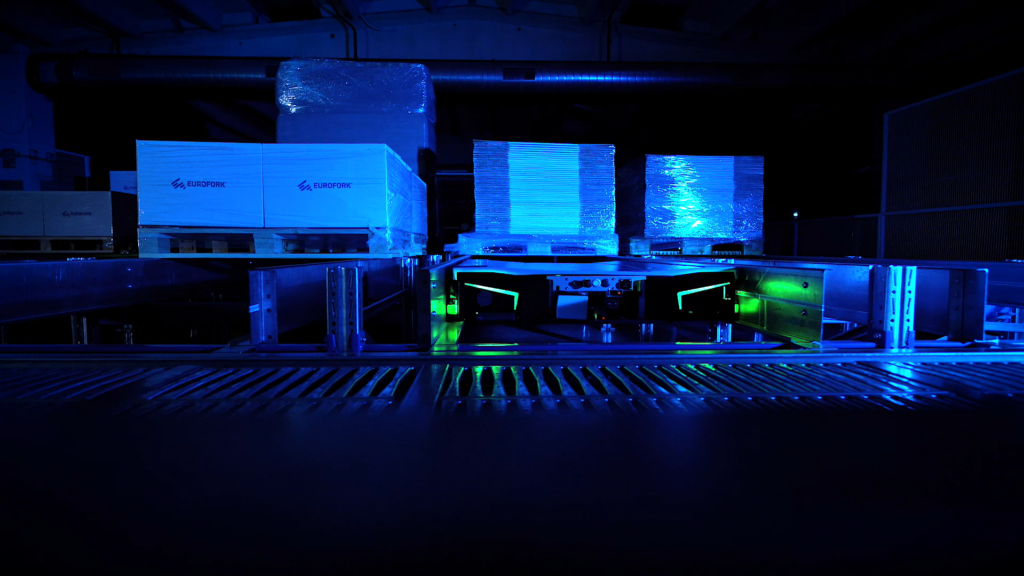
These systems are based on autonomous shuttles that move loads within the racking structure, enabling high throughput and increased storage density.
– Miniload Systems
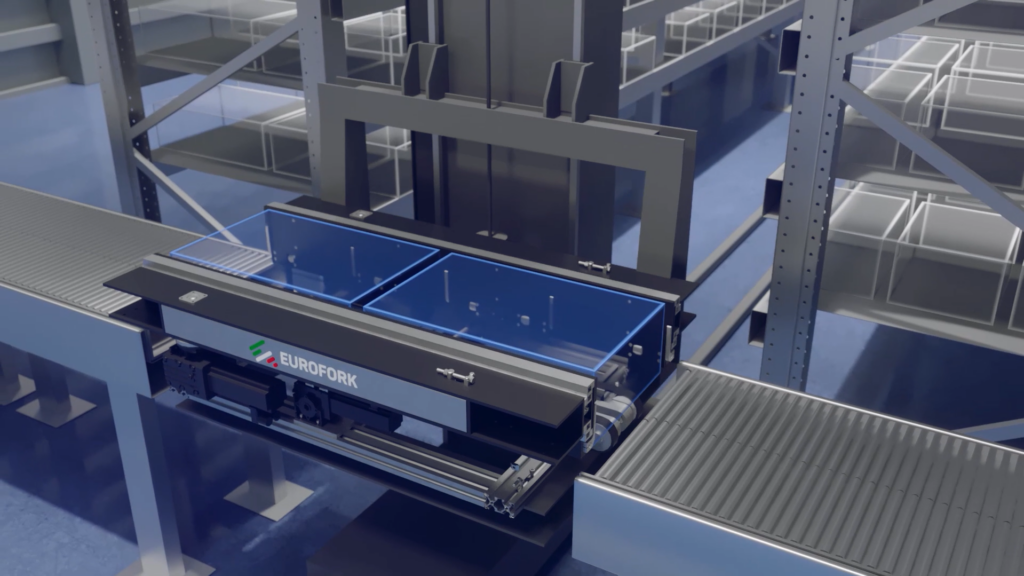
Designed for the automated handling of bins, totes, and small cartons, these systems can be implemented using miniload stacker cranes equipped with telescopic forks for boxes or dedicated shuttle systems capable of ensuring high performance, handling accuracy, and rapid access to materials.
– Automated Vertical Storage Systems
The adoption of an AS/RS is generally associated with a range of operational benefits widely recognized in the automated logistics sector.

What Are the Benefits of an AS/RS?
The adoption of an AS/RS is generally associated with a range of operational benefits widely recognized in the automated logistics sector.
– Space Optimization
Automated management and the use of vertical space enable higher storage density compared to traditional warehouses.
– Greater Accuracy
Automation reduces handling and inventory errors through digital control of operations.
The availability of accurate and up-to-date inventory data is becoming increasingly important in modern supply chains, where visibility and information reliability directly influence service levels and operational planning.
– Increased Productivity
Automated material handling enables continuous workflows and high operating speeds.
According to Deloitte’s analysis on warehouse automation, companies are increasingly investing in warehouse automation to improve order processing speed, enhance operational accuracy, and reduce logistics process cycle times.
– Improved Safety
Reducing manual activities in storage areas helps decrease operators’ exposure to potentially hazardous situations.
Deloitte’s analysis also points out that automation is being adopted not only to increase productivity but also to reduce dependence on labor availability and support logistics continuity.
– Inventory Traceability
AS/RS systems provide up-to-date information on the location and status of materials stored in the warehouse.
The ability to monitor inventory in real time is now one of the key requirements for companies investing in supply chain digitalization and logistics flow integration.
AS/RS and Automated Warehouses: Is There a Difference?
The two terms are often used interchangeably, but they do not indicate exactly the same concept.
An automated warehouse refers to the entire automated facility, including structures, software, transport systems, and operational processes. An AS/RS, on the other hand, more specifically identifies the system responsible for the automated storage and retrieval of load units.
In other words, an AS/RS generally represents the operational core of an automated warehouse, but it can also be integrated into broader and more complex logistics architectures.
Conclusion
The importance of AS/RS solutions is expected to continue growing in the coming years. The 2025 MHI Annual Industry Report – The Digital Supply Chain Ecosystem identifies automation, robotics, and digitalization among the main investment priorities for companies seeking to make their supply chains more resilient, efficient, and data-driven.
An AS/RS is an automated system designed to perform storage and retrieval operations in a controlled, traceable, and highly efficient manner. Rather than being a single technology, it represents a category of solutions encompassing different architectures, handling devices, and operating methods, all sharing the same objective: automating inventory management and internal warehouse material flows.

Contact Us
To request further information, fill out the form. Our sales department is available to help you with your next intralogistics automation project.